George was in the kitchen wearing clean jeans and a white T-shirt, checking a grocery list on the refrigerator. The lobster magnet held it in place. Beside the door, his cane rested in the wooden rack Nolan and Sadie had built. The yellow star painted on the top had grown slightly chipped, but nobody had suggested repainting it.
Sadie appeared in the doorway with one shoe on and one bare foot.
“The other one’s vanished.”
“Have you checked your room?”
“Of course.”
“Under the bed?”
“Definitely.”
“Behind the door?”
She stopped, considered, and vanished. A moment later she returned holding the shoe triumphantly.
“You didn’t see that,” she said.
“See what?”
“Exactly.”
He handed her a piece of toast. It was golden brown, not burnt, though Sadie maintained that perfectly cooked toast was less interesting than toast with a story.
George checked the time. He had an appointment at the clinic after work and would need to leave early enough to avoid rushing. The store had a shipment arriving before noon. Janelle had already sent him a note about two purchase orders requiring verification. Paul’s grandson was visiting the store later to ask about a summer job. There would be invoices, questions, and more than one person who thought their order ought to be handled first.
It would be a normal Monday.
Sadie ate while reading a library book. She paused over a paragraph and asked what the word resilience meant.
George thought about it. The word had been used to describe him after the fair, usually by people who knew nothing of his life except a video. He had never liked the way it sometimes turned hardship into an expectation that a person should keep enduring anything placed in front of them.
“It means being able to recover after something difficult,” he said. “Or find a way to keep going. But it doesn’t mean you have to do it by yourself.”
“So asking for help can be resilient?”
“Absolutely.”
She considered this. “Then our paper bridge was resilient.”
“In its own papery way.”
She closed the book and stood. The repaired front tooth caught the kitchen light when she smiled. She put her bowl in the sink, pulled on her backpack, and kissed George’s cheek before heading toward the door.
“Love you, Dad.”
“Love you more.”
“Not possible.”
“Scientists are still debating it.”
She rolled her eyes and stepped outside to meet Mrs. Moreno, who walked with her to the corner on mornings when George needed an early start.
George watched them cross the courtyard. Mrs. Moreno said something that made Sadie laugh. The two disappeared around the building, one tall and deliberate, the other moving with the impatient speed of childhood.
He looked around the kitchen. The rent was manageable, though not effortless. The truck ran, though it was old. His knee would always require attention. Elena was still gone, and there would be days when the absence returned sharply. The county assistance application remained pending. None of those facts needed to be hidden for him to call this a good life.
His phone buzzed with a message from Nolan: How’s the old man’s leg?
George typed back: Older than the rest of him. But we’re good.
A second message arrived: Don’t do anything stupid this week.
George smiled and replied: That’s a high standard. I’ll try.
He put the phone down, collected his keys, and took the cane from its rack. Before leaving, he opened Elena’s blue notebook, now kept on a shelf beside a bowl of apples. On the newest page, beneath a list of expenses and school dates, he had written one short sentence.
We are doing better. Not because everything is fixed. Because we are not doing it alone.
He closed the notebook and stepped outside.
At work, the stockroom was waiting. The day would bring its small irritations, its problems and corrections, its ordinary human disagreements. George would sit at his desk, check the numbers, call suppliers, and find solutions that did not require anyone to be afraid of him.
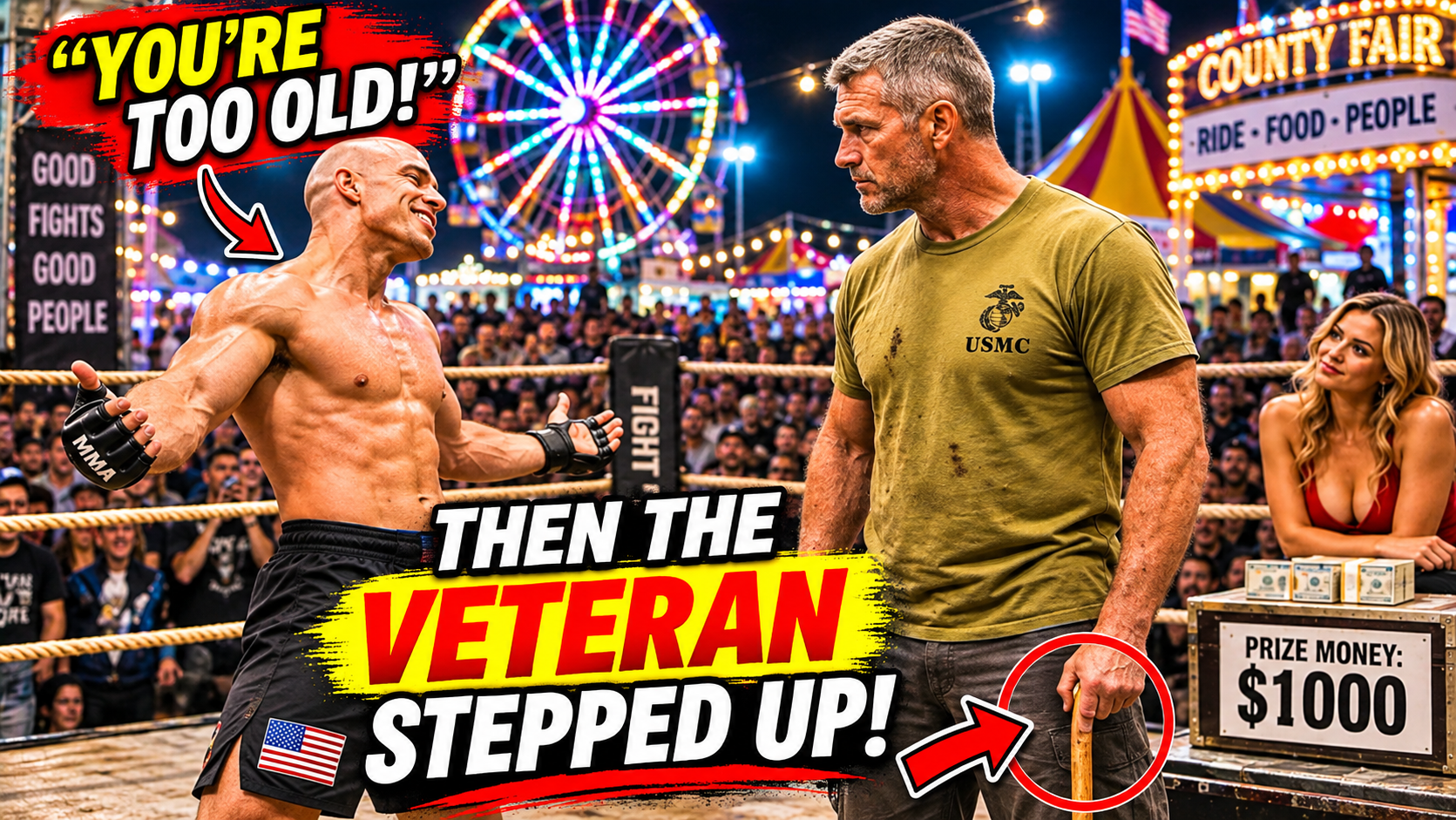
There would be no announcer, no cage, no crowd demanding a spectacle. Nobody would offer a thousand dollars for four seconds of his time.
He had once believed the remarkable part of his story was the moment he raised his cane and entered the ring.
Now he knew the harder part had been everything that came afterward.
He started the truck and drove toward the hardware store, through the streets of a town beginning its Monday, carrying a lunch his daughter had packed for him. Inside the bag was a sandwich, an apple, and a small note in purple marker.
Remember to eat something green. The apple doesn’t count. Love, Sadie.
He laughed all the way to the first traffic light.
EPILOGUE: NO AUDIENCE
A year and a half after the night at the fair, somebody in a distant city sent the video around again. It was one of those internet events nobody could explain: an old clip resurfacing beneath a new caption, gathering viewers who knew nothing of the life that had continued after it ended.








