THE MUSTANG THEY TRIED TO STEAL
A police chief was accused of stealing his own father’s car. The neighbors thought his badge would be the biggest surprise. They were wrong.
PROLOGUE: THE WRONG MAN TO ACCUSE
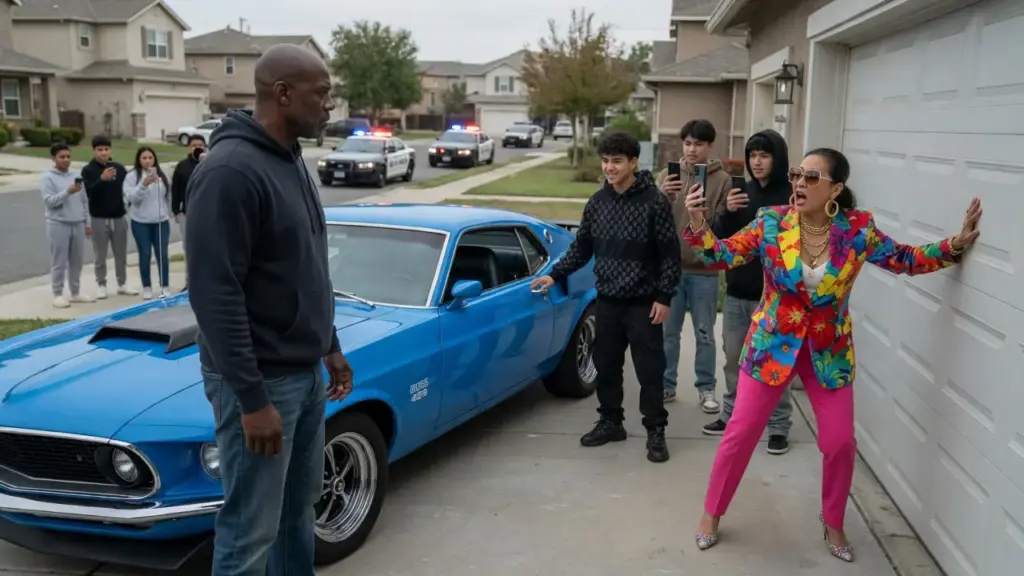
The first police cruiser turned onto Hawthorne Lane at 7:14 on a Saturday morning. By 7:16, three officers were standing in Elijah Grant’s driveway, staring at a blue 1969 Mustang and the woman insisting it belonged to somebody else.
“Arrest him,” Vivien Hartman said. “I have proof. I want him arrested before he gets rid of it.”
Her seventeen-year-old son, Logan, filmed from behind her shoulder. His grin had the desperate excitement of someone who had arranged a public humiliation and intended to replay it later.
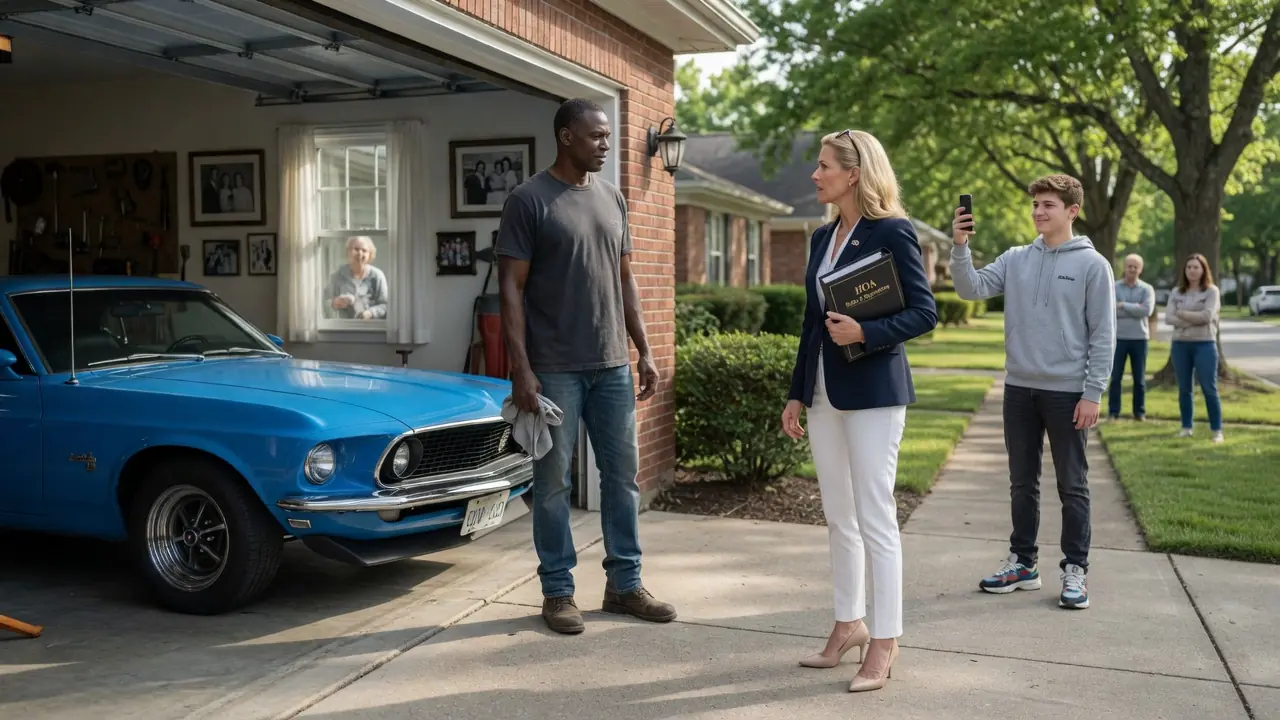
Elijah stood beside the garage with his coffee growing cold in his hand. He was a tall Black man with a close-cropped beard, a gray T-shirt, and a look of tired patience that people frequently mistook for weakness.
Officer Miguel Rivera took one look at him and stopped walking.
“Chief Grant?”
Vivien turned. “What did you call him?”
“Chief,” Rivera repeated, suddenly much more careful about where he placed his feet. “That’s Chief Elijah Grant.”
The smile vanished from Logan’s face. His phone dipped toward the driveway.
But Elijah did not look pleased. He looked at the white recovery truck rolling slowly past the entrance to the street, its amber lights off, its flatbed empty. The driver slowed when he saw the police. Then, without stopping, he accelerated away.
Nobody had requested a tow.
Elijah watched the truck disappear around the corner.
And for the first time that morning, he understood something the Hartmans had not meant him to understand.
Someone had expected his Mustang to be gone before he could prove it was his.
Three weeks earlier, Elijah had wanted nothing more than a quiet home.
CHAPTER 1: FIVE YEARS IN A GARAGE
The house in Maple Ridge Estates had three bedrooms, a narrow backyard, and a two-car garage with just enough space to open both doors without scraping the walls. Elijah chose it because the kitchen caught the morning light and because the garage had a solid concrete floor.
At fifty-two, after more than two decades in law enforcement, he had finally bought his first house. Apartments, temporary assignments, late calls, and the long, expensive aftermath of a divorce had kept him moving for years. The promotion to chief of police had given him a larger salary. More importantly, it had given him a reason to stop postponing the life he kept promising himself.