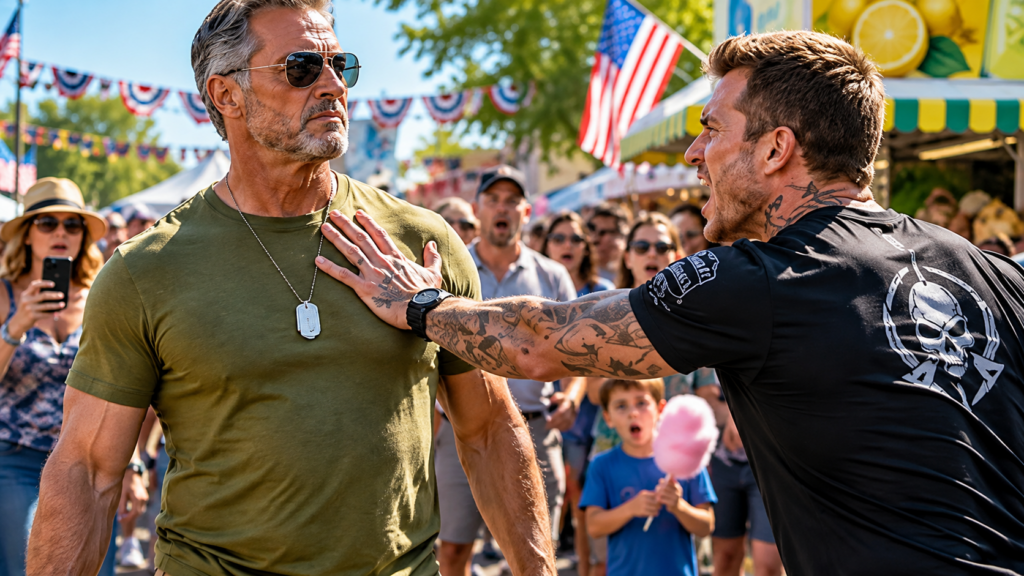

The most dangerous men in the world look like nothing at all. They wear worn cargo shorts to 4th of July cookouts and carry black coffee in a dented travel mug. They hold doors open for strangers without making eye contact.
They drive 10-year-old trucks with rust bleeding around the wheel wells and a first-aid kit under the seat that has never once been used for a paper cut.
They move through the world with the unhurried deliberateness of men who have nothing left to prove because they proved everything that mattered a long time ago in places that don’t appear on travel brochures. The man who is genuinely dangerous almost never looks it.
That is in fact the point. Owen Briggs was 57 years old and he looked every one of them.
The back of his neck was the color of old saddle leather, a permanent condition earned across three combat deployments in Afghanistan and one in Iraq. He had reading glasses now, wire-rimmed bifocals he kept forgetting on the kitchen counter, and a left knee that predicted rain more reliably than the National Weather Service. His hair had gone silver at the temples before he was 40 and finished the job by 50.
He was not a big man, not a broad fill-the-doorframe man. He was medium in almost every category the eye could measure, height, build, the quiet way he occupied space. His hands were the only giveaway if you knew what to look for. The left one was missing the ring and little finger, a clean absence that stopped below the second knuckle.
He’d lost them to a pressure plate device on a dirt road outside of Kandahar 15 years ago.
The medic had wrapped the hand and Owen had continued the mission. He’d filled out the incident report 3 days later in dry bureaucratic language that failed entirely to describe what that road had looked and smelled like at 0300 hours. He didn’t think about it anymore. Four fingers were enough for most things.
He was standing in the shade of a parking lot elm at Riverside Park watching his 9-year-old grandson Caleb negotiate the economics of the corn dog cart with a focused intensity of a junior senator. The park was a riot of noise and color, July 4th in full breathless swing. The smell was classic American chaos. Charcoal smoke, bug spray, cheap sunscreen, and the sharp metallic bite of fireworks being test popped somewhere near the water.
A brass band further south was working gamely through a Sousa march that kept losing ground to the base thumping from a portable speaker near the pavilion. The crowd was thick with lawn chairs, coolers, and small children sprinting between adult legs. Owen tracked all of it without appearing to track any of it. His eyes moved behind his sunglasses at their own steady pace, not anxious, not paranoid, just running the baseline, the unconscious calculus of a man who spent 22 years in special forces.








