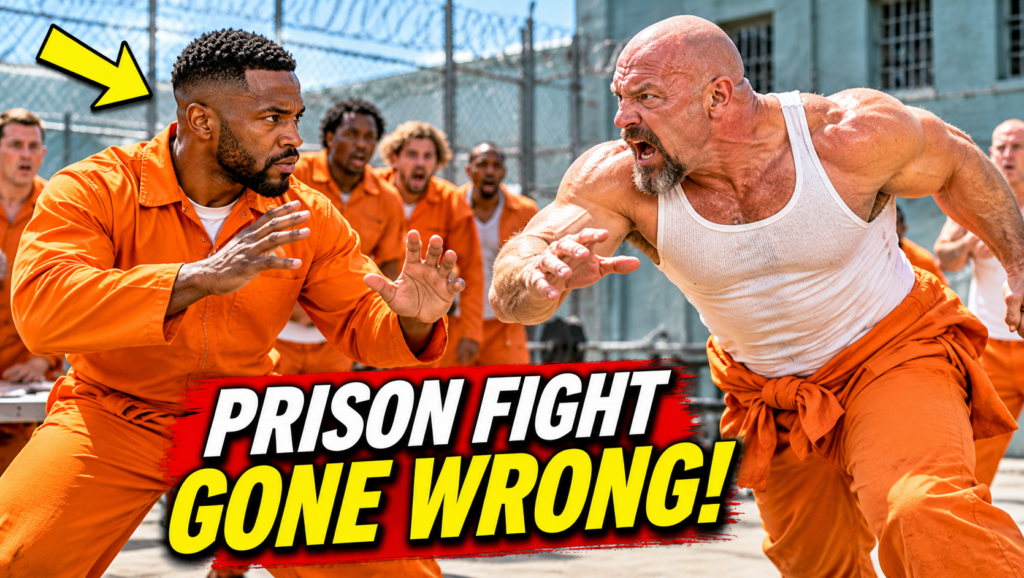
You’re in my bed. Move.
The quiet black man had been inside Block D for less than 30 seconds.
Jumpsuit still creased from processing, paperback under his arm.
“Guard assigned me here.”
Twenty men stopped breathing.
Nobody had refused Slade in nine years.
Slade grabbed his collar, yanked him close, tobacco breath, yellow teeth.
“I don’t care what any badge says. This is my house. My rules.”
He shoved Caleb into the wall.
The paperback hit the floor.
“You’re nothing. Less than nothing. And from this second, you’re mine now.”
Caleb’s shoulder throbbed where it struck concrete.
He looked at Slade. No anger, no fear.
He picked up his book, sat on the bunk, opened it.
That silence was the moment Slade decided to destroy him.
He just didn’t know it would be the worst decision of his life.
Six months before Block D, Caleb Quinn taught a Tuesday night class at the East Side Athletic Center in Baltimore.
Eight adults stood in a half circle on blue mats.
He walked between them, adjusting a wrist angle here, a foot position there.
“Again,” he said.
His voice barely carried past the first row.
The woman closest to the door threw a palm strike. Too slow. Too wide.
Caleb caught her wrist mid-swing, redirected it, and tapped two fingers against her ribcage before she registered what happened.
“You telegraphed,” he said.
“Your shoulder moved before your hand. Try again.”
She tried again.
This time, he didn’t catch it.
“Better.”
That was Caleb’s way.
Few words, clean technique, no performance.
He’d been teaching self-defense at Eastside for six years.
Krav Maga as the foundation, layered with Brazilian Jiu-Jitsu for ground control, and Muay Thai for close-range striking.
He’d built the curriculum himself, drawing from 18 years of training that started in a cramped gym above a laundromat when he was 16.
His first instructor was a retired Israeli military combat trainer named Avi Rosen.
Avi didn’t believe in belts.
He believed in repetition.
Caleb spent two years drilling the same 12 disarm sequences until his hands moved before his brain gave the order.
By 18, Avi told him there was nothing left to teach.
So Caleb went looking for more.
Brazilian Jiu-Jitsu at a gym in Fells Point.
Muay Thai under a former Lumpinee Stadium fighter who’d settled in DC.
He cross-trained obsessively, not to compete, but to understand how different systems of violence connected.
Where Krav Maga ended, BJJ began.
Where BJJ left you exposed, Muay Thai filled the gap.
At 24, a friend talked him into entering an amateur MMA tournament.
Caleb didn’t want to.
He wasn’t a fighter. He was a technician.
But he stepped into the cage anyway.








