For an instant Trent looked disappointed, then embarrassed. The shove should have produced a stumble. He had spent so many hours practicing how to make other people move that stillness felt like an insult.
“Look at you,” he said. “You won’t even defend yourself.”
Naomi studied the young man’s face. Up close she could see a tiny scar beside Trent’s eyebrow and the bright, frantic movement of his eyes. He was nineteen, dressed like a fighter, trying to settle a question about himself in front of an audience. Naomi thought of Daniel’s final months and the promise she had made during the hours when he was too tired to speak.
She needs a mother who comes home.
Trent poked a finger into her shoulder. “What are you going to do, old lady?”
Naomi saw a dozen ways to put the boy on the ground. The recognition came automatically, with a precision she no longer wanted. It was the part of herself she had worked so hard to set aside. Then Khloe pressed her face against her back, and the question changed. She was not deciding whether she could beat Trent. She was deciding what her daughter would remember.
She stepped backward.
“I won’t fight you in front of my child,” she said.
“Because you’re scared.”
“If that’s what you want to believe, you can believe it.”
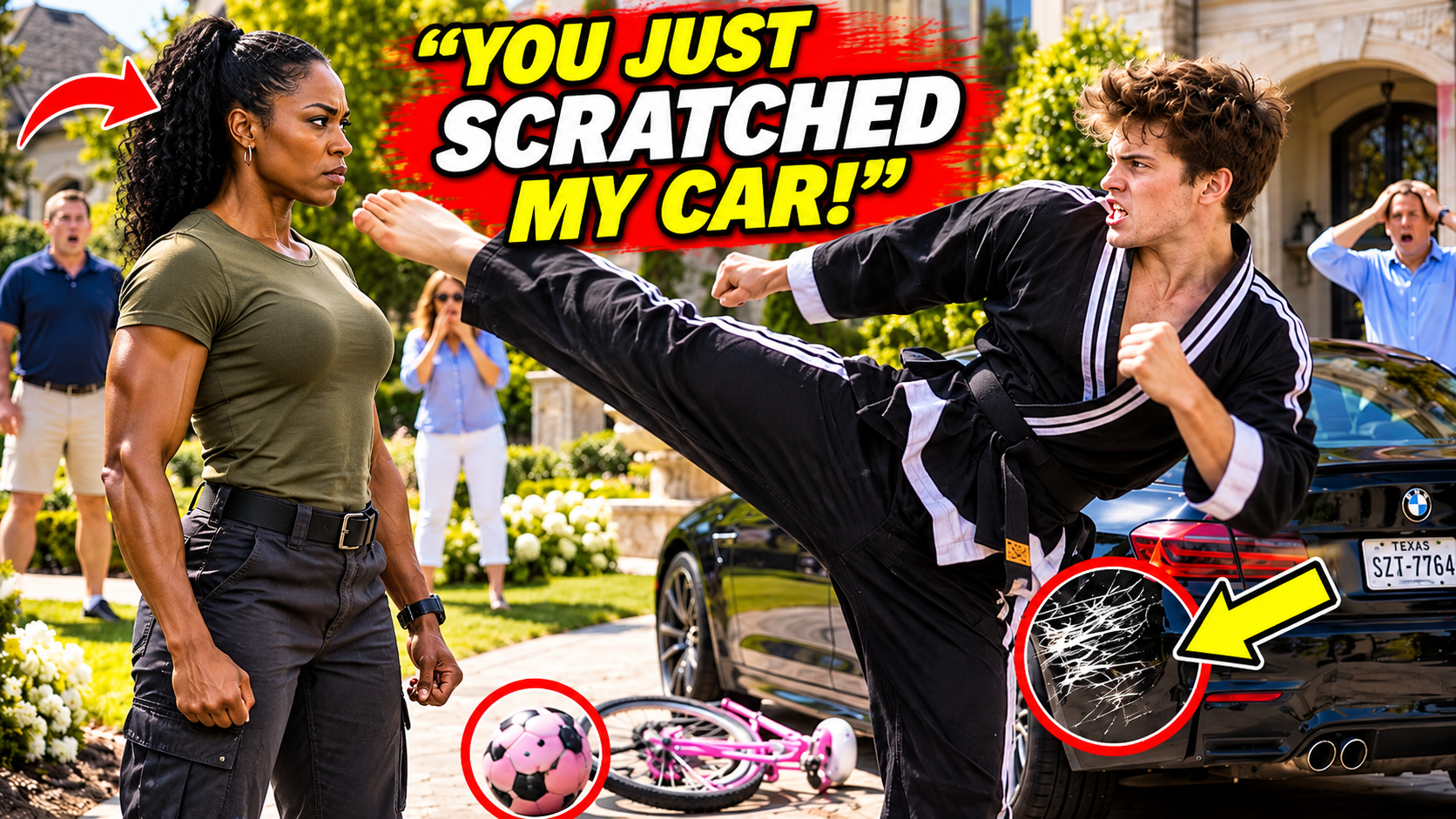
Trent smiled at the neighbors, satisfied that he had found a line that sounded like victory. “That’s right. Walk away.”
Naomi bent to retrieve the bicycle. She took Khloe’s hand, careful of her scraped palm, and led her across their driveway. Trent called after them, louder with each step.
“Elite Striking, Friday night! Open mat! Come see what a real fighter looks like!”
Naomi did not turn. She carried the bicycle into her garage, closed the door, and checked the lock on the front door for no good reason except that her hands needed something ordinary to do.
Khloe stood in the hallway, shivering despite the warmth.
“Mommy,” she whispered, “did I make that man hurt you?”
Naomi crouched, ignoring her knee. “No, Bug. You scratched a car. He decided to be cruel. Those are two different things.”
“But if I’d stayed here, he wouldn’t have pushed you.”
“His behavior is his responsibility. The scratch is ours to repair.”
She considered the distinction, then began to cry. Naomi held her until the sobbing slowed. Over her shoulder, through the narrow window beside the door, she could see Trent still talking to the neighbors.
It was astonishing how much trouble a young man could make out of six inches of damaged paint.
Chapter 7: The Story She Took to Bed
The scraped palm needed cleaning. Naomi brought out the small first-aid box from beneath the kitchen sink, sat Khloe at the counter, and rinsed the grit from the skin. She watched her hands with the grave attention of a child who had witnessed something frightening and wanted to know what came next.
“Will it hurt?” she asked.
“A little. I’ll tell you before it does.”
She did. She hissed when the antiseptic touched her palm, then glared at the bottle as though it had personally betrayed her. Naomi covered the scrape with a bandage decorated with cartoon planets. Daniel had bought the box two months before he died, insisting that ordinary bandages were too dreary for an adventurous girl.
“Captain Buttons needs one too,” Khloe said.
“Where?”
“Her ear. Emotional damage.”
Naomi gave a startled laugh. The phrase sounded so much like Daniel that her eyes stung. She placed a bandage around the rabbit’s ragged ear and bowed solemnly.
“Treatment complete.”
Khloe smiled. It lasted only a moment. “Why did you say you were a coward?”
“I didn’t say I was one. I let him think what he wanted.”
“Isn’t that the same?”
Naomi pulled a chair close. She had learned that children did not need grand speeches when they were frightened. They needed an adult who would sit still long enough for the question underneath the question to emerge.
“Sometimes people say things because they want you to do something. If they make you angry enough, they get to choose what happens next.”
“Like when Maya dares me to jump off the swings.”
“Exactly.”
“But you could have pushed him back.”
“I could have.”
“Would you have won?”
The question hung between them. Naomi remembered a road at night, a shattered radio, a young man’s face before she understood how quickly things could change. She did not want any of that in her daughter’s kitchen.
“Winning isn’t always the important part,” she said. “Sometimes the important part is getting home without anyone else getting hurt.”








