
The most dangerous men in the world look like nothing at all. They wear worn cargo shorts to 4th of July cookouts and carry black coffee in a dented travel mug. They hold doors open for strangers without making eye contact. They drive 10-year-old trucks with rust bleeding around the wheel wells and a first-aid kit under the seat that has never once been used for a paper cut.
They move through the world with the unhurried deliberateness of men who have nothing left to prove because they proved everything that mattered a long time ago in places that don’t appear on travel brochures. The man who is genuinely dangerous almost never looks it. That is in fact the point. Owen Briggs was 57 years old and he looked every one of them.
The back of his neck was the color of old saddle leather, a permanent condition earned across three combat deployments in Afghanistan and one in Iraq. He had reading glasses now, wire-rimmed bifocals he kept forgetting on the kitchen counter, and a left knee that predicted rain more reliably than the National Weather Service. His hair had gone silver at the temples before he was 40 and finished the job by 50.
He was not a big man, not a broad fill-the-doorframe man. He was medium in almost every category the eye could measure, height, build, the quiet way he occupied space. His hands were the only giveaway if you knew what to look for. The left one was missing the ring and little finger, a clean absence that stopped below the second knuckle.
He’d lost them to a pressure plate device on a dirt road outside of Kandahar 15 years ago. The medic had wrapped the hand and Owen had continued the mission. He’d filled out the incident report 3 days later in dry bureaucratic language that failed entirely to describe what that road had looked and smelled like at 0300 hours. He didn’t think about it anymore. Four fingers were enough for most things.
He was standing in the shade of a parking lot elm at Riverside Park watching his 9-year-old grandson Caleb negotiate the economics of the corn dog cart with a focused intensity of a junior senator. The park was a riot of noise and color, July 4th in full breathless swing. The smell was classic American chaos. Charcoal smoke, bug spray, cheap sunscreen, and the sharp metallic bite of fireworks being test popped somewhere near the water.
A brass band further south was working gamely through a Sousa march that kept losing ground to the base thumping from a portable speaker near the pavilion. The crowd was thick with lawn chairs, coolers, and small children sprinting between adult legs. Owen tracked all of it without appearing to track any of it. His eyes moved behind his sunglasses at their own steady pace, not anxious, not paranoid, just running the baseline, the unconscious calculus of a man who spent 22 years in special forces.
Exit sightlines, bodies in motion, bodies standing too still. It wasn’t something he chose to do. It was the same as breathing. Grandpa, they only have mustard left. Caleb turned around. His face caught between disappointment and philosophical resignation. He was a small kid, gap-toothed with his mother’s brown eyes and a sunburn across his nose that was going to hurt by Thursday.
Is mustard okay? I personally don’t like mustard, but I’ll eat it if you want. I like mustard, Owen said. You do? Caleb looked genuinely surprised as if this required full recalibration of his understanding of his grandfather. Get two. Caleb turned back to the cart with renewed purpose.
Owen’s daughter Megan was 14 miles away at Valley General, somewhere in the determined and inconvenient process of delivering her second child. Megan’s husband Drew was with her, useless and devoted in equal measure. Babysitting duty had fallen to Owen by default, a duty he accepted without complaint. He was better with Caleb than most people assumed.
He didn’t have a loud personality or a talent for crafts, but he knew how to pay attention, and children responded well to being genuinely paid attention to. Caleb had been nervous this morning, the way kids get when they understand something important is happening, but aren’t allowed inside the room where it’s happening. Owen had taken him to the park, bought him a snow cone, listened to a 20-minute explanation of a video game he would never play, and said very little.
By lunchtime, Caleb had stopped being nervous. That was Owen’s primary skill set in civilian life, keeping the people he was responsible for from getting hurt by things he saw coming before they did. He just wanted a quiet afternoon. Bryce Colton moved through a crowd the way a plow moves through snow, not navigating it, displacing it.
He was 23 years old, built like a fire hydrant, running on protein powder and residual adrenaline, and approximately 48 hours removed from winning the regional open amateur title at a mid-tier MMA promotion held in a casino ballroom in Henderson. The belt was plastic, the opponents were regional, and the victory was real enough. To Bryce, this was cosmically indistinguishable from a UFC championship.
He had been telling people about it, loudly, constantly, since the referee raised his hand, and he had arrived at Riverside Park today not to enjoy the holiday, but to be witnessed enjoying it. He wore a compression shirt so tight it functioned as a display case for his heavily tattooed arms. His shorts were branded with his gym’s logo, Apex Combat, Henderson, NV, and his sneakers were white and pristine, the aggressively maintained white that communicates priority.
His girlfriend, Simone, walked beside him scrolling through her phone. Behind him, Devin and Kayla served the function of the entourage, filming everything for the social media channel Bryce had been running for 11 months with the hungry, unsuccessful energy of someone who has not yet understood that the algorithm does not care about your belt. He had cut the corn dog line twice already, the second time with enough shoulder that the young couple he’d displaced had simply stepped back without objecting.
Bryce fed on that. A small daily confirmation that the world moved when he pushed it. Caleb was carrying two corn dogs on paper trays moving carefully through the crowd. Eyes fixed on the mustard cups balanced at the edge of each tray. He was 9 years old. He was 60 lb. He was not watching where he was going because he was watching the mustard.
He walked directly into Bryce’s path. The collision was incidental. A small boy’s shoulder against the side of the larger man’s knee. Caleb bounced backward, fumbled, and one tray tipped. The mustard cup skipped off the cardboard edge and landed squarely on Bryce’s pristine right sneaker releasing a small yellow sunburst across the toe box.
Caleb looked down, looked up. His mouth opened. I’m so sorry. I didn’t I didn’t see you. I’m really sorry. Bryce stared at his shoe. The flush started below his collar and climbed. “Are you serious right now?” he said. Not to Caleb. Not really to anyone. The voice of a man performing outrage rather than feeling it. A distinction that had stopped mattering to him somewhere along the way.
He squared his frame toward the boy. “Do you know what these cost? $300. 300. How old are you? You got $300? Because somebody’s paying for these.” Caleb had gone pale. He stood perfectly still. The remaining corn dog tray held in front of him like a shield. His lower lip beginning the preliminary work of trembling.
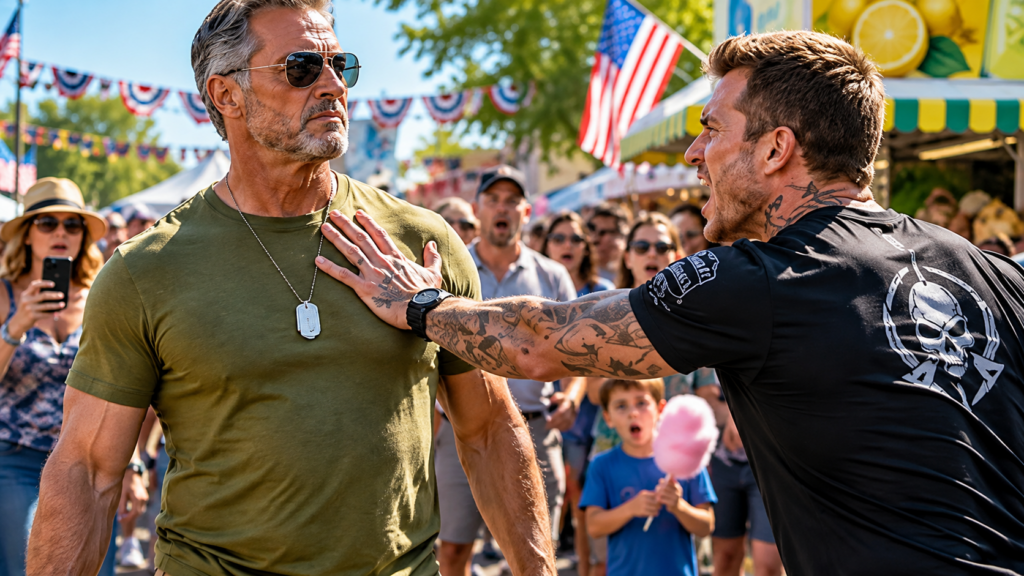
Owen was already moving. He’d seen it from 15 yd. He’d seen the tray tip, seen the mustard, seen the large tattooed man rotate toward a 9-year-old with his chest squared and his volume climbing. Owen covered the distance without hurrying, without breaking stride. He just shortened the time between here and there.
He stepped in front of Caleb. One smooth unhurried lateral placement that put his body directly between his grandson and the man now staring down at them. He stood with his hands loose at his sides, shoulders forward just a fraction. Not aggressive, not readable as aggressive, but immovable. “Hey.” Owen’s voice was level, not loud. “It was an accident. He’s 9 years old.”
Bryce shifted his gaze. He took Owen in the way a man glances at a speed limit sign before continuing to accelerate. He registered a compact older man in faded cargo shorts and a gray t-shirt, soft at the middle, silver-haired, wearing drugstore sunglasses. He noticed the missing fingers on the left hand briefly, the way you register something slightly odd without knowing what to do with the information.
He filed Owen under not a factor. “Accident.” Bryce repeated, tasting the word. He glanced back at Devon’s camera. He had an audience. “Your kid just ruined my shoes, old man. Accident still means somebody pays.” “He’s 9.” Owen said again, same flat, measured tone. “His mother’s in the hospital right now. He’s been through a long day. He didn’t see you. Neither one of us is paying you $300.”
He held Bryce’s gaze without blinking, not challenging, not hostile, the way a man makes eye contact when he has genuinely nothing to prove. “The hospital.” Bryce let the word sit there, playing it to Devon’s phone. “So, that’s the sympathy angle.” He stepped forward, closing the distance, occupying Owen’s space.
“Here’s what happens. You take out your wallet, you give me 300 for the shoes, and I forget your grandkid exists. That’s the deal. Or we have a different kind of conversation.” “No deal.” Owen said. Bryce. The script he’d been running had not included that word. People at this point in the routine bargained.
They apologized excessively. They did the anxious, overcorrecting thing of people who wanted a problem to simply stop existing. Owen did none of it. He just looked at Bryce with the incurious steadiness of a man watching weather move across a flat field. You got a lot of nerve, Frey. We’re done here. Owen turned.
He reached down, took Caleb’s free hand in his right, and began walking. The crowd had already formed its loose crescent, the morbid geometry of bystanders anticipating something they can tell their friends about later. Phones were rising from pockets. Devon and Kayla were filming without quite knowing what story they were telling yet. Simone had stopped scrolling.
The thing about Bryce Colton was this. He understood instinctively that the only way to own a crowd was to never let anyone walk away from him. Being dismissed was worse than being argued with. Being ignored in front of witnesses was a form of violence his nervous system could not process. Hey, the word hit Owen’s back like a thrown object. Hey, I’m talking to you.
Owen kept walking. You do not walk away from me. Bryce closed the 6 ft in two heavy strides and planted both hands between Owen’s shoulder blades, hard, aggressive. The kind of shove designed to put a man face-first on the ground in front of an audience. Owen stopped. He didn’t stumble. He didn’t pitch forward.
He absorbed the force by dropping his weight instantly through his hips to his heels. The thing a body does when the body has been trained for it for two decades. Devon’s camera caught the moment in clean focus. A compact older man shoved hard by a trained fighter 30 years his junior who simply stopped as though the laws of physics had issued a local amendment specifically for him.
The carnival noise of the park went muffled. The way noise goes muffled when something in the immediate vicinity has shifted into a different register entirely. Owen released Caleb’s hand. He did not look back yet. He knelt, his bad knee grinding in its familiar way, a complaint he ignored, and brought himself to eye level with his grandson.
Caleb. His voice had changed. not louder, not faster, stripped clean. Every soft civilian texture gone from it, replaced by something precise and calm that carried its own weight. I need you to walk over to the lady at the corn dog cart, the one with the yellow apron. You stand next to her, you face the river, and you do not look back here. Do you understand me?
Caleb’s lower lip was working hard. His eyes were bright and frightened. Grandpa. This is not dangerous, Owen said. I need you out of the way so I can finish a conversation. Go now. Caleb went. He moved fast, holding his corn dog against his chest. Owen stood up. He turned around.
What happened in Owen Briggs’ mind in the next 2 seconds took no measurable time at all. 22 years in uniform had done something to his neurological baseline that no amount of civilian living had fully undone. The adrenaline cascade that floods an ordinary man’s system in a confrontation, the shaking hands, the tunneled vision, the voice that climbs a half octave, simply did not occur.
His cardiovascular system ran a cool, practiced subroutine. His heart rate dropped. His hands went still. The ambient park noise resolved into a set of clean tactical inputs. He looked at Bryce Colton the way a structural engineer looks at a load-bearing wall. Assessment, not judgment. Male, early 20s. Heavy muscle mass concentrated through the chest and shoulders.
Stance too wide, tournament training, controlled environment, not real contact experience. Weight bias too far forward on the lead leg. Chin elevated, arrogant, exposed. Both hands hanging low, breathing visible. Chest rising every 2 seconds, already running hot. The anger is sloppy. Sloppy anger moves predictably. Threat level, manageable.
I’ll give you one chance, Owen said. He did not raise his voice to meet the crowd. The words moved through the park noise at their own frequency, and the people nearest them heard every syllable clearly. Walk away. Go enjoy your holiday. Go home. Nobody has to remember today.
Bryce spread his hands wide for Devon’s camera and grinned. A grin that didn’t reach the eyes. Do you even know what I do? Do you watch the regional circuit at all? I have a title, bro. I literally “I know what you do,” Owen said. He felt nothing particular. No performance of anger for the crowd. No manufactured cold. Just the flat settled awareness of a man who had made a decision and was waiting for the other party to catch up.
Last chance. Bryce’s face went flat. He’d run out of words. He loaded his right shoulder and threw the punch. It was not a bad punch, technically. A large, fully committed overhand right with Bryce’s considerable body weight driving through it. The same punch that had finished his last four opponents inside the Apex Combat Regional Series.
It came with speed and with genuine bad intentions. Owen simply was not in its path when it arrived. He moved in, not back, not sideways, in. A tight pivot on the ball of his right foot, 4 in left. Bryce’s fist cut through empty air close enough that Owen felt the displaced pressure against his ear.
The miss carried Bryce’s momentum forward and down, overextending the right arm, dragging his torso out over his lead knee, rolling his jaw directly across Owen’s sight line like a slow pitch over the center of the plate. Owen’s right arm came up, open hand. The motion was maybe 7 in of total travel. No windup, no preparation the eye could detect.
All compression and hip rotation. A technique practiced so many thousands of times over so many years that it had passed entirely out of the realm of conscious thought and into the same category as breathing. The heel of his palm connected with the point of Bryce’s jaw. The sound it made was flat and hard, nothing like the movies. More like a dense piece of green wood being snapped across a knee.
Bryce Colton’s eyes went empty, not closed, empty. The competitive fire, the manufactured confidence, the entire fragile architecture of his public identity shut off simultaneously, the way a building goes dark when the main breaker trips. His legs became water beneath him and he fell straight down. No drama, no trajectory, no staggering. He hit the grass on his back and lay still.
The park held its breath. Devon’s camera was still running. Owen lowered his hand. He did not stand over Bryce. He did not look at the crowd, at the phones, at the frozen expressions of Devon and Kayla. He turned toward the corn dog cart where Caleb stood with his face half hidden behind the yellow-aproned vendor’s arm, peeking through his fingers with one eye.
Owen walked over. He ducked under the rope cordon and crouched in front of his grandson. “Hey,” he said. The warmth was back in his voice, easy and complete as if it had never left. “You okay, bud?” Caleb nodded. His eyes were enormous. Did he fall? Something like that.
The vendor, a heavy-set woman named Grace with a kind face and steady hands that were not entirely steady at this moment, handed Caleb a replacement corn dog without being asked. Owen thanked her quietly. The park ranger arrived 4 minutes later, a compact man in his late 30s named Harmon, moving through the reopening crowd with the unhurried, deliberate stride of someone who had done crowd control in considerably more demanding circumstances.
He assessed Bryce, who was now sitting up with the baffled, fragile movements of a man who does not understand what floor he’s on, jaw swelling visibly along the left side. Then Harmon looked at Owen. His eyes ran their inventory. The level breathing, the hands visible and open, the way Owen was standing, weight balanced, head still, neither elevated nor diminished. Not the posture of a man still running on adrenaline, the posture of of man who has already closed the file and filed it away.
Harmon had done two tours in Ramadi as a Marine infantry sergeant. He knew exactly what he was looking at. He held his hand out to Devon and watched the video for 30 seconds without his expression changing. Then he handed the phone back. “You might want to think carefully about posting that.” Harmon said. “It shows your friend shoving this man from behind, then throwing the first punch.”
He turned to Owen. “Self-defense. Clear as I needed it to be.” He walked Owen a few yards from the crowd. “You put a 200-lb trained fighter on the ground in under 2 seconds.” Harmon said, keeping his voice low. “And your heart rate doesn’t look like it moved. Where’d you serve?” “Army.” Owen said. “Which unit?” “Fifth Special Forces Group.”
Harmon nodded once, the nod of a man receiving information he had already deduced. “Happy Fourth.” he said. “You too.” Owen said. Caleb was quiet in the back seat for most of the drive to Valley General. Owen watched him in the rearview mirror, the small, serious face, the dried blue stain of earlier snow cone at the corner of his mouth, the concentrated expression of a child processing something large in a small-sized mind.
The late afternoon light was coming in warm and low through the windshield. The highway stretched ahead, cutting through the green suburban sprawl of the county. Owen’s right hand ached across the palm in that dull, familiar way. Not sharp, just present. A receipt. He thought about what he had done. He always did afterward. He could not help it.
The geometry of the moment, the margin. 2 in of difference in angle or in force and the outcome is not a concussed young man with a swollen jaw. It is something the paramedics handle differently. Something that follows Owen home in a more permanent way. The line between those two outcomes was terrifyingly thin and Owen had walked it for for years.
And the fact that his body had found it instinctively, automatically, after 15 years of home improvement projects and school pickups and early bedtimes, that fact unsettled him in the quiet, specific way of something he would never say out loud. He was grateful for the outcome. He was not comfortable with the fluency. The tremor came in his right hand somewhere around exit 14.
It always came afterward when the mechanism stood down and the body remembered what it had been asked to do. Owen kept both hands on the wheel and breathed through it. Four count in, four count out, the old protocol. Grandpa? He looked at the mirror. Yeah, bud. Why was that man so mad? Caleb was watching the trees pass. It was just mustard. Mustard washes off.
Owen was quiet for a long moment. Some people, he said finally, build everything they feel about themselves out of things other people can see, the way they look, the fights they win, whether strangers step back when they walk past. And when something messes with any of that, even something small, even a little mustard, it feels to them like the whole building is falling down.
He paused. The problem is that’s not a building. That’s a costume. Caleb thought about this. So, he wasn’t really tough. He’d worked hard. He was tough at some things, but those things weren’t enough for him to feel okay without someone watching. Owen’s voice was steady. That’s a different problem, a harder one than it looks.
Caleb was quiet for another mile. You didn’t yell, he said then. It wasn’t a question. It was an observation delivered in the careful, empirical tone that nine-year-olds sometimes find when they’re paying real attention. Even when he pushed you, you didn’t yell once. No. How come?
Owen looked in the rearview mirror at his grandson, the gap-toothed mouth, the brown, serious eyes, the sunburned nose that would peel by Thursday morning. Because yelling is what happens when you’ve already lost control of yourself, Owen said. And I couldn’t afford that. Not with you standing there.
Caleb absorbed this the way he absorbed most things Owen said, without rushing, turning it over. Your hand, he said, after a moment. The fingers that aren’t there. He’d been orbiting this question all day. That happened in the army? Yeah. Did it hurt? For a while.
Caleb nodded solemnly. He had decided not to ask the follow-up because he could already see it led somewhere heavy. Instead, you’re not like other grandpas. Owen almost smiled. No. I mean that good. I know you do. They pulled into Valley General’s parking structure at 5:47 in the evening.
Owen cut the engine. His phone buzzed on the center console. A text from Drew. She’s here. 6 lbs 4 oz everybody’s perfect. Room 314. Owen sat with that for a moment. 6 lbs 4 oz everybody’s perfect. He looked up at the hospital’s glass facade, the evening light slanting off it in broad warm panels.
Ready? He said. Is she here? Caleb sat bolt upright, seatbelt suddenly the enemy. Is the baby actually here? 6 lbs 4 oz. Let’s go. He was already pulling at the buckle with both hands. Owen got out of the truck. He stood alone in the parking structure for a moment, in the quiet, in the cool smell of concrete and exhaust and old motor oil, and let the day find its level.
Somewhere across town in a park, a young man with a swollen jaw was recalibrating something fundamental about how the world actually operated. That was not Owen’s problem anymore. Devon’s video would circulate or it wouldn’t. People would form whatever opinions they formed. Online comments would be written by strangers who had not been there and would never understand what being there felt like.
None of that belonged to Owen. What mattered was through those automatic doors, a daughter who had just done something extraordinary, and a new small person who had entered the world knowing nothing yet about the weight of it. Owen was going to be the one standing in that room. He was going to hold that baby with his four-fingered left hand and his steady right hand, and he was going to be the quietest and most certain thing in the room, the way he always was.
He walked toward the doors. Caleb ran ahead, sneakers squeaking on the concrete, and held one open. There are men walking among us right now who have been to the places the evening news discusses in careful distanced language. Men who have done things that kept other people safe precisely because those things were done in the dark by people who did not need anyone to know their names.
Most of them look like nothing in particular. They wear cargo shorts. They drink bad coffee. They stand in line at the corn dog cart on the 4th of July, holding the hands of the grandchildren they are quietly, absolutely devoted to protecting. They are not looking for a fight, but if someone decides to bring a fight to the people standing behind them, to the small, the vulnerable, the ones who depend on them for the simple fact of their safety, they will end it without performance, without hesitation, without a single word louder than necessary.
The loudest man in the crowd is advertising something he is afraid he doesn’t have. The quiet man beside him, the one who is watching everything and saying nothing, is the one who has already decided how this ends if it has to end at all. True strength does not need an audience. It needs only the discipline to hold itself in reserve and the clarity to act without flinching when everything that matters is standing right behind you.








