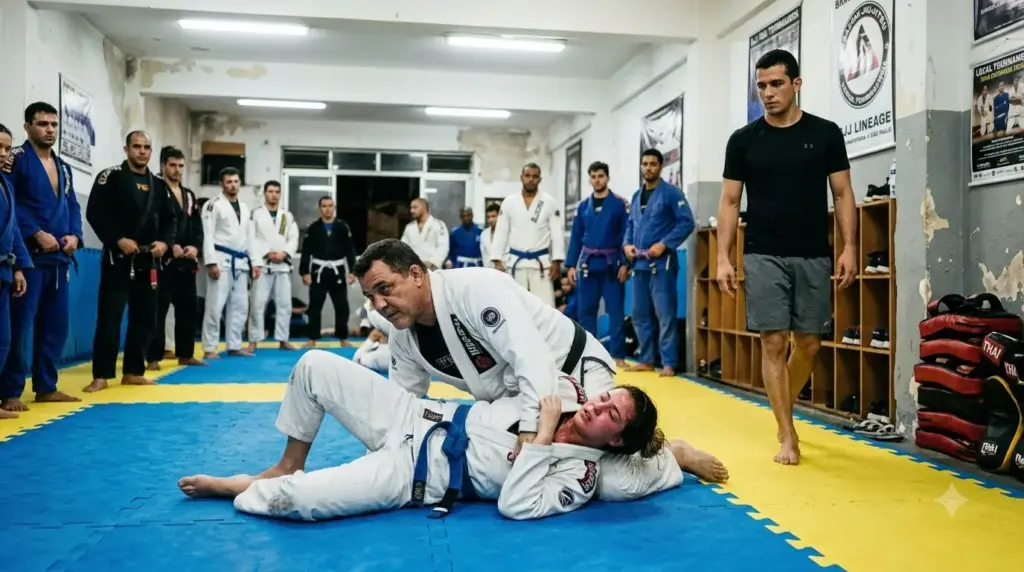

The first tap was light.
The second was not.
Seventeen-year-old Tessa Monroe slapped the man’s forearm with the flat of her right hand.
Once.
Twice.
Three times.
Tap.
The black belt holding her did too.
He was thirty-three.
White.
Six feet one.
Brazilian jiu-jitsu black belt.
Owner and head instructor of Forgepoint Grappling in St. Louis.
He had Tessa’s back.
One hook across her hip.
The other trapped under her thigh.
His right forearm was tucked beneath her chin.
His left hand locked behind her head.
The choke was clean.
Tessa tapped.
Cole tightened.
Not much.
Just enough.
He smiled.
“Don’t wait that long next time.”
Tessa’s eyes widened.
She tapped again.
Harder.
Cole did not release.
From the corner of the room, a woman stood up.
She had been sitting on a folding chair beside the water cooler for almost forty minutes.
No gi.
No belt.
No gym bag.
Dark jeans.
Black sweater.
Brown leather boots.
Her hair was pulled back into a low bun.
She was forty-five.
Black.
Calm.
Until that moment, almost nobody in the room had paid attention to her.
She stepped onto the edge of the mat.
“Let her go.”
Cole looked over without releasing.
“She’s fine.”
The woman took another step.
“Let her go now.”
Something in her voice changed the room.
Not volume.
Certainty.
Cole released.
Tessa fell forward onto both hands.
Coughed.
One palm went immediately to her throat.
The timer on the wall still had eleven seconds left.
That was where the problem began.
Forgepoint Grappling occupied the second floor of an old brick warehouse in the Central West End.
The building had once housed a printing company.
Now it held a coffee roaster downstairs, an architecture studio in the rear, and Forgepoint across most of the upper floor.
The gym was polished but not luxurious.
Gray mats.
White walls.
Black trim.
A line of heavy bags near windows.
Competition medals in a glass case.
A small office with frosted glass.
A motto painted over the entrance to the mat:
PRESSURE REVEALS CHARACTER.
Cole had chosen the words himself.
He liked them because they worked on social media.
He liked them because they sounded tougher than “learn slowly.”
He liked them because they explained his coaching style.
Cole believed in pressure.
Not cruelty, he would say.
Pressure.
He believed beginners panicked too soon.
He believed people mistook discomfort for danger.
He believed martial arts worked only if students stayed long enough inside fear to learn it did not own them.
A lot of his students loved him for that.
Some improved because of it.
Some left quietly.
Cole interpreted most departures as people choosing comfort.
That was part of the problem.








