“Keep doing the work,” Barnes replied. “We’ll discuss it when the time comes.”
For once, Trent accepted an uncertain answer without trying to force it into a promise.
Chapter 55: When a Smaller Boy Needed a Friend
One afternoon, Trent overheard two older students making jokes about Owen, the nervous beginner. They had seen him stumble during practice and were imitating his movements in the locker-room corridor. Owen stood near the water fountain pretending not to hear.
Trent felt the familiar temptation to respond with a sharp insult. He could easily make the two older students look foolish in front of their friends. He knew how to do that. He had done it to people for years.
Instead he walked over and asked the students to stop.
One laughed. “What are you, his bodyguard?”
“No,” Trent said. “He’s here to learn. Leave him alone.”
“Since when do you care?”
The question was fair. Trent had built a reputation for making other people feel small. He could not erase it by acting decently once.
“Since I found out what it feels like,” he answered.
The boys looked at him, uncertain whether he was serious. Then one shrugged and walked away. The other followed. There was no confrontation, no challenge, and no dramatic proof that Trent was the strongest person in the hallway.
Owen watched them leave. “Thanks,” he said.
“You don’t owe me anything. If it happens again, tell Lena or Coach.”
“Okay.”
Trent stood awkwardly for a moment, then asked whether Owen wanted help with the next drill. The boy nodded. They returned to the mats together.
Lena had witnessed the exchange from the front desk. She did not applaud or announce it to the room. Later, while cleaning equipment, she told Trent she’d noticed him stepping in without escalating.
“I almost said something stupid,” he admitted.
“What stopped you?”
He considered. “I remembered how it felt when everybody was watching and nobody cared whether I was scared.”
Lena nodded. “Then use that memory well.”
The next day Trent worked a morning shift at the sporting-goods store and helped Patrice reorganize the fitness aisle. A customer asked about a beginner class for his son. Trent gave him the gym’s information and mentioned that Barnes had improved the safety procedures.
For the first time, his recommendation was not an advertisement for his own talent. It was an honest description of a place where someone could learn.
Chapter 56: Richard Learns to Ask
On a cold Saturday morning, Richard asked Trent if he wanted to come to one of the dealerships. He did not offer a management title or a position created for the owner’s son. He asked whether Trent would be interested in seeing the service department work, then added that it would be fine to say no.
Trent agreed, partly because he was curious and partly because he had rarely heard his father offer a choice without making the answer feel like a test.
At the service center, Richard introduced him to Carla, the manager responsible for scheduling repairs and speaking with customers whose cars had developed problems. She showed Trent how estimates were prepared, why labor costs varied, and how easily a small paint repair could become expensive if the finish had to be matched precisely.
Trent listened more carefully than Richard expected. He asked what happened when a customer disputed the estimate.
“We explain the work,” Carla said. “We don’t treat them like they’re bad people for asking questions. Most are already worried about money.”
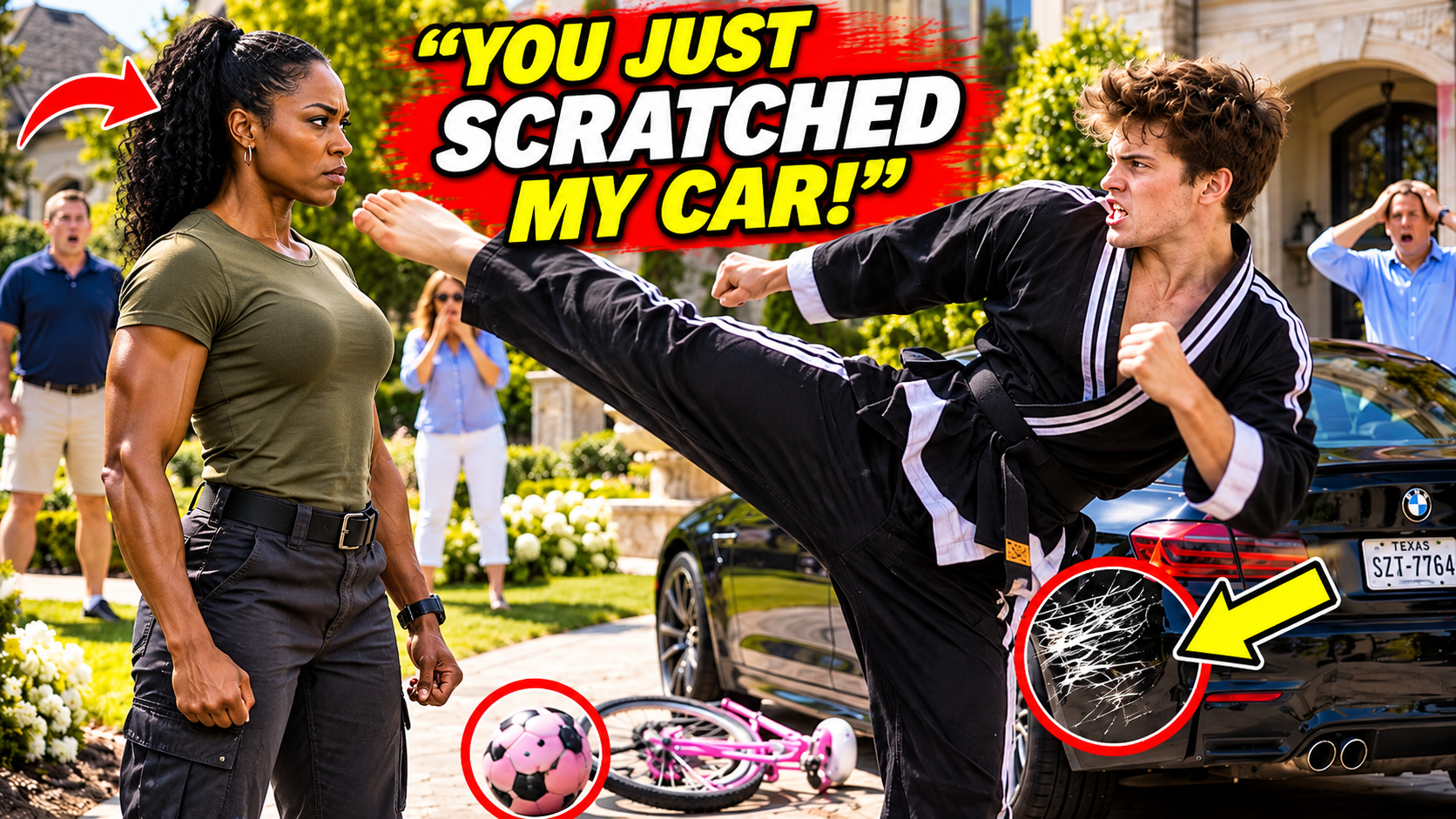
Trent remembered the day Khloe’s pedal scratched his BMW. He had shouted about the cost before anyone could even tell him what the repair would involve. Now the amount seemed less important than the way he had used it to frighten a child.
On the drive home, Richard asked whether he liked the work.
“Some of it,” Trent said. “Carla knows everything.”
“She’s excellent.”
They drove in silence for several miles. Then Richard said, “I think I taught you some things badly.”
Trent looked over. “Like what?”
“I told you winning was all that mattered. I bought you things every time I wanted to make you feel successful. I didn’t always ask what you needed.”
Trent stared at the road ahead. He had spent years wanting his father to say he was proud. Hearing him admit a mistake felt unexpectedly frightening, as if a piece of the family structure had shifted.
“I liked the car,” he said.
Richard laughed softly. “I know.”
“But I didn’t like when everyone acted like it meant I had my life figured out.”
Richard nodded. “I can understand that.”








