A few people shifted in their chairs. Henderson looked down at his hands.
Delia asked whether there was video of those events. Mary said there were photographs of the blocked driveway, a copy of the flyer, and Joseph’s notes. She explained what she had witnessed and made clear which details she had heard directly rather than learned later.
Then Evelyn spoke. “My son behaved badly. I want that included. And I also want it included that the gym should not have let the situation become a fight.”
Delia blinked. She had expected the Harringtons to present a united accusation against their neighbor.
“Of course,” she said, somewhat stiffly.
Joseph stood. He had prepared a written statement, but the faces in the room made him put it aside. These were people who had waved at his daughter, borrowed tools, asked for help with broken pipes, and discussed schools at the bus stop. They did not know him particularly well, yet many had formed strong opinions about him in the space of thirty-one seconds.
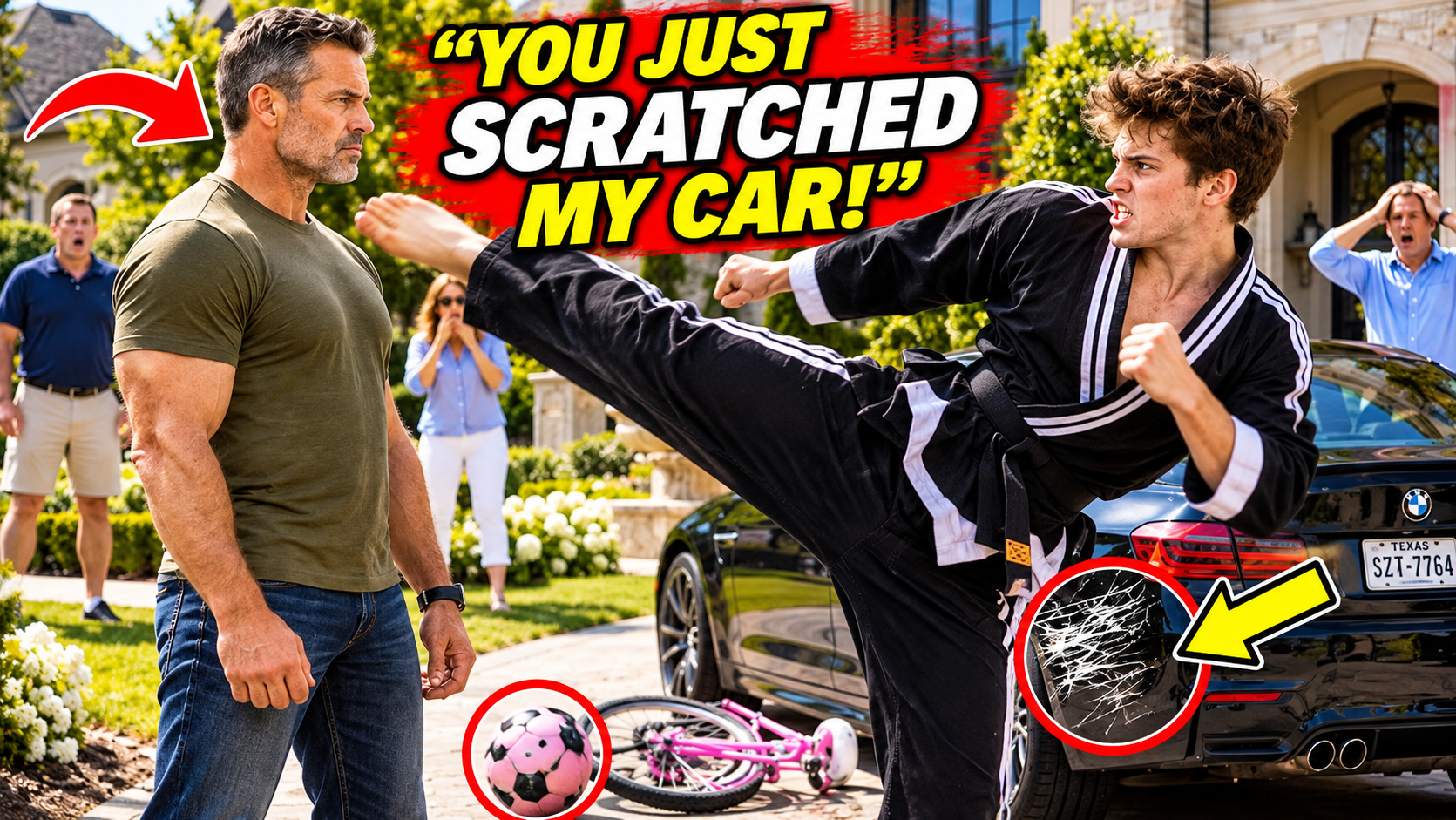
“My daughter scratched Trent’s car,” he began. “She was riding her bike and lost control. I offered to pay for the repair. I have paid the full bill. What happened after that was unnecessary. Trent shouted at her, shoved me, and continued provoking me over several days. I should have asked for outside help rather than accepting his invitation to spar.”
He paused. The room was quiet.
“At the gym, I had control of the exchange. When he tapped, I didn’t release as quickly as I should have. That was wrong. The coach addressed it, and I accept responsibility for it. I won’t pretend it was justified because I had been insulted.”
Someone in the second row asked whether Joseph had military training. He could hear the curiosity underneath the question. It was not about policy. The person wanted to know why the video looked the way it did.
“I served in the Navy,” Joseph replied. “That doesn’t change whether the decision was right or wrong.”
Delia asked whether he had intended to hurt Trent. Joseph considered the wording carefully.
“I intended to stop him. At one point I also wanted to frighten him. I regret that. I want the harassment to end, and I want my daughter to be able to ride her bicycle without feeling that every adult argument on this street is about her.”
For the first time, the meeting sounded less like a court judging a dangerous stranger and more like a group of neighbors deciding what they owed one another.
Then Trent stood up.
Chapter 35: The Boy Who Stopped Performing
The sudden movement drew every eye in the room. Trent felt the familiar heat of attention, the same sensation that had pushed him to shout on the driveway and perform at the gym. This time he had nothing clever prepared.
“I started most of it,” he said.
Richard turned toward him. Evelyn did not move. She simply watched her son speak.
“The girl scratched my car. I got mad. Mr. Miller offered to pay. I shoved him anyway. Then I left the flyer and blocked his driveway. I went into his backyard. I said something about his wife that I shouldn’t have said.”
He swallowed. The room remained silent.
“I told people he was scared of me because it made me feel better. It wasn’t true.”
A man near the fireplace shifted awkwardly. Delia looked toward the table where she had arranged her notes. She had never heard the young man describe the events without laughter.
“And the fight?” she asked.
Trent stared at the floor. “I invited him. I wanted everyone to watch me win. I got scared when it didn’t go the way I thought. He shouldn’t have kept going after I tapped, but I shouldn’t have set it up to humiliate him either.”
Joseph listened without interrupting. The apology was not addressed to him yet, and he was glad of that. Trent was not trying to win Joseph’s approval. For the first time, he was correcting a story because it was wrong.
Devin, who had come at Trent’s request, raised a hand. “I have the complete video. I made the short version and posted it. That’s on me.”
Delia nodded for him to approach. The full recording played. It showed the agreement to spar, the coach’s instructions, the young man’s aggressive opening, the rapid reversal, and the failure to release instantly after the tap. There was no longer a clear hero or villain on the screen. There were choices, made by identifiable people, and consequences that had traveled farther than anyone expected.








