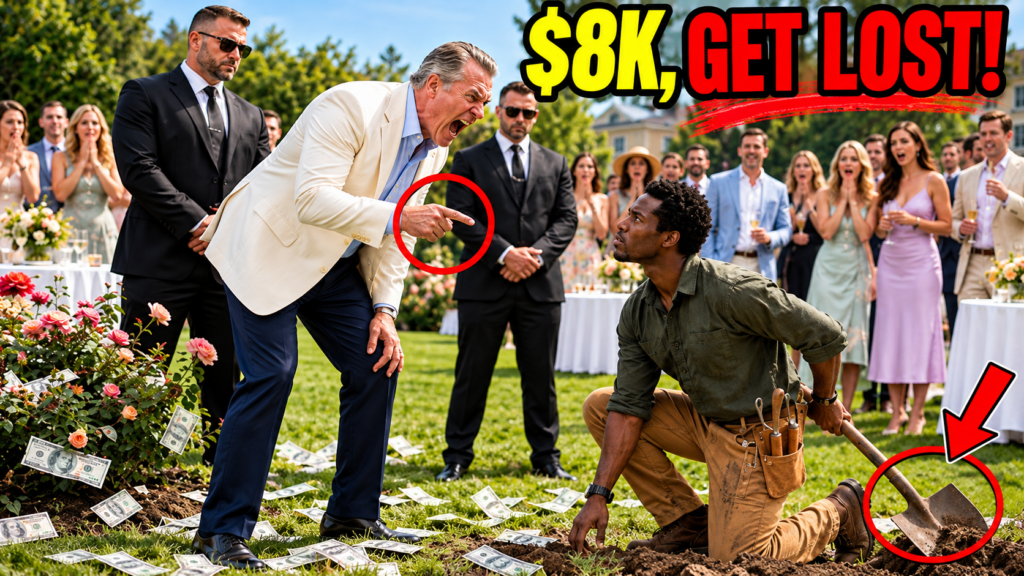
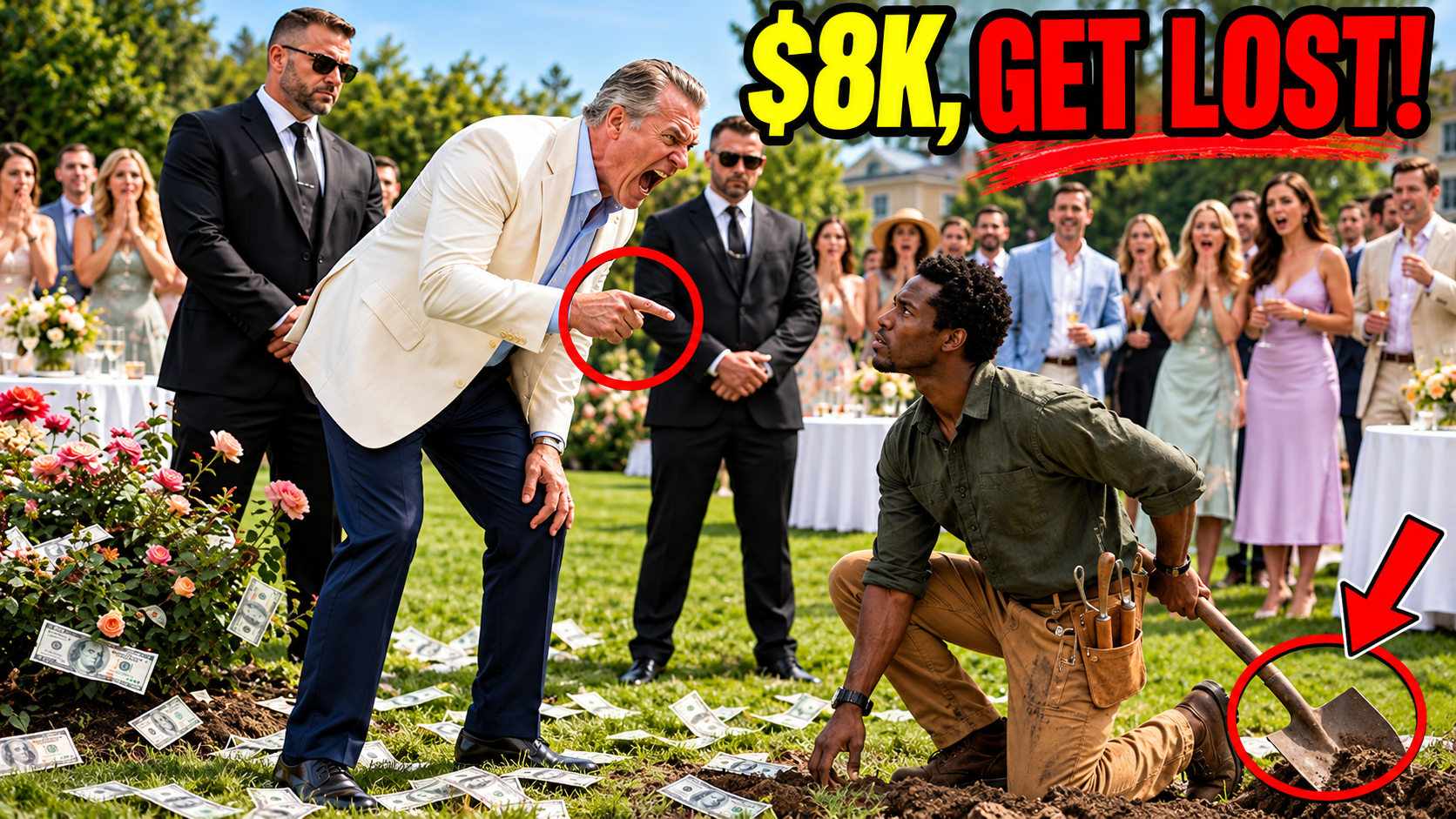
“Take this money and get lost, you delusional fool.”
$8,000 scattered across the lawn. Bills catching in rose bushes, drifting into champagne glasses.
“Sir, I have my dignity. I can’t.”
Sterling Whitmore laughed, and one by one, the guests laughed with him.
“Dignity? Consider it charity, boy, because you’re fired.”
“Sir, I haven’t done anything wrong.”
Sterling stepped closer, his shadow falling over Andrew’s face.
“Your presence here is already a stain, boy. Someone like you was never meant to stand on my grass.”
Andrew’s fists clenched. He knelt, picked up every bill one by one, and walked out. Nobody at that party knew that one year later those $8,000 would change everything. And Sterling Whitmore, the billionaire who threw them as a joke—what he saw would drop his jaw to the floor.
The sky was still gray when Andrew Jacobs pushed open the iron gate of Whitmore Estate. Five in the morning. The grass was cold and wet beneath his boots, and a thin layer of dew covered every leaf, every petal, every blade. He knew this garden the way a painter knows a canvas—every rose bush, every stone path, every bed of lavender that lined the eastern wall. He had planted them all three years ago, when this five-acre stretch was nothing but patchy grass and overgrown hedges. Now it was something else entirely.
The first light of dawn broke through the old oak canopy and spilled across the walkway in gold ribbons. Dew drops on the David Austin roses caught the light and turned into tiny diamonds. The air smelled like wet soil and lavender and freshly cut grass—the kind of smell that hits you before your eyes are fully open. Andrew walked barefoot across the lawn. He always did. He liked the way cold grass pressed between his toes. It told him things. How moist the soil was, whether the roots were drinking, whether the ground needed rest.
He stopped at the eastern border. The boxwood hedge stood in a perfect line, each branch trimmed at exactly the same angle. He had done that yesterday. Took him four hours. Nobody would notice. Nobody ever did. He pulled a worn notebook from his back pocket. The cover was falling apart, held together by a rubber band. Inside, every page was filled. Sketches, layouts, color palettes organized by season, drainage maps, sun exposure charts drawn from months of observation. This was Andrew’s real work. Not the digging, not the weeding—the designing. Every curve in the walkway, every cluster of flowers, every line of sight from the terrace to the fountain. He had planned it all in this notebook, then built it with his own hands. But nobody knew that. To Sterling Whitmore, Andrew was the man who mowed the lawn, nothing more.








