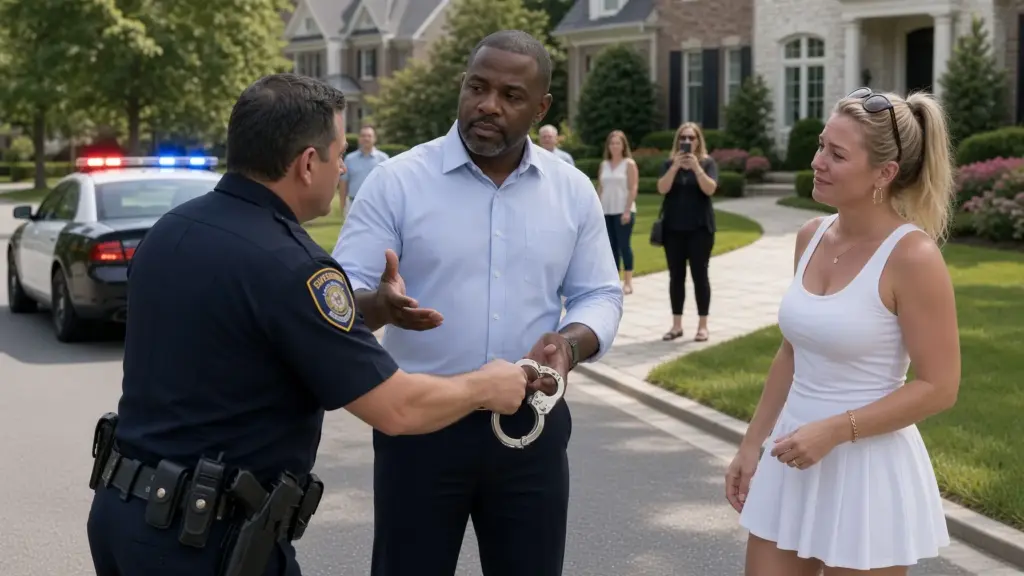
The scream shattered the quiet of Asheford Pines before anyone on the street understood what had happened. Evelyn Whitmore staggered backward across her immaculate driveway, one hand pressed dramatically against her left cheek, while the other pointed toward the Black man standing several feet away on the sidewalk. “Stay away from me!” she cried loudly enough for curtains to move in three neighboring houses. “Don’t you come near me again!” Malcolm Greer did not move. His hands remained open at his sides, his breathing steady despite the sudden attention gathering around them. “Mrs. Whitmore,” he said quietly, “I never touched you.”
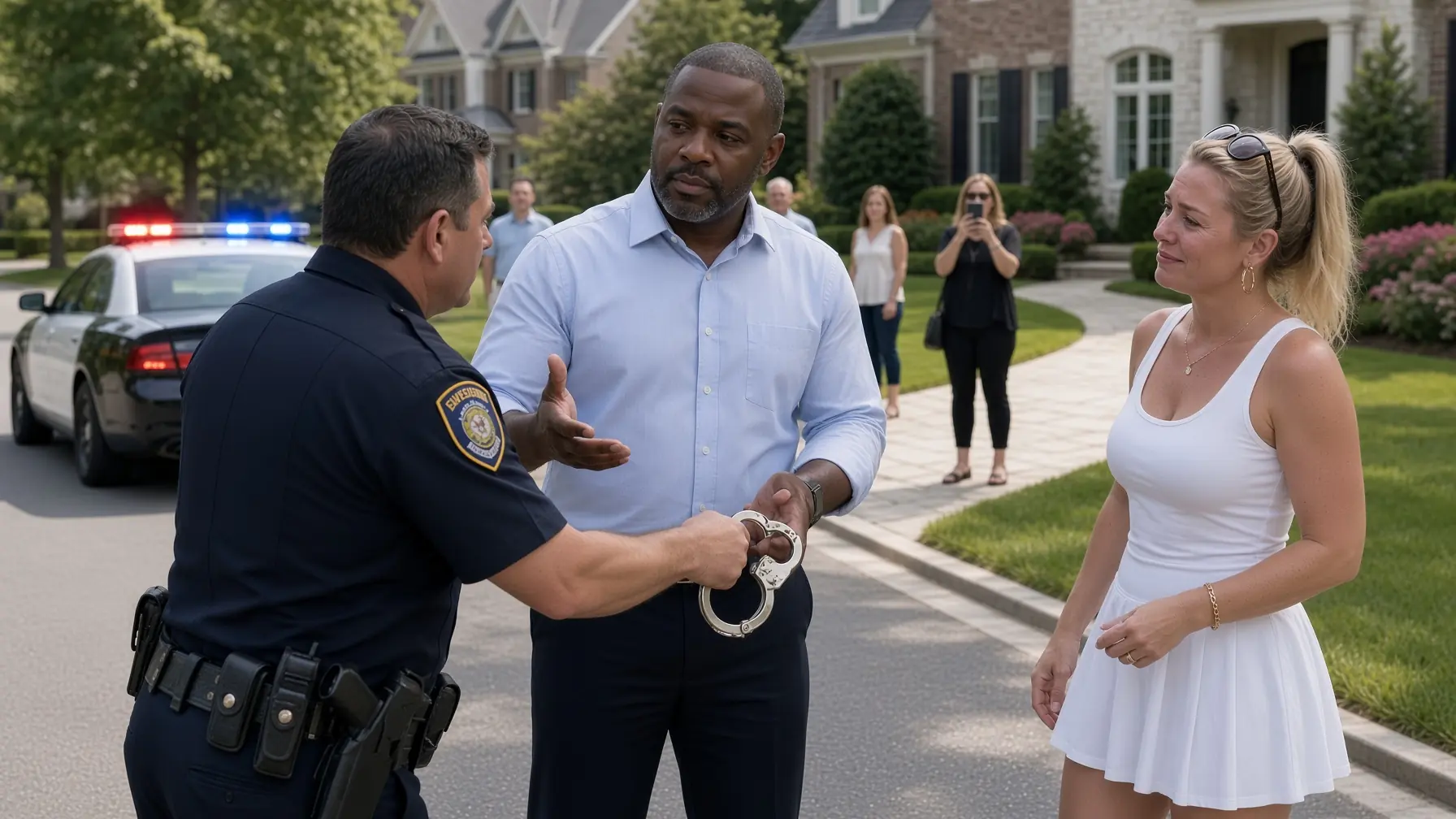
Evelyn’s eyes were wet almost instantly, but there was something strangely controlled beneath the tears. She raised her phone and aimed it toward Malcolm as though creating evidence after the fact. “Don’t stand there pretending nothing happened,” she snapped. “You hit me. I know exactly what you did.” Malcolm glanced toward the houses now watching them and then back at her. “If you call the police, tell them exactly what happened.” Evelyn’s thumb was already moving across the screen. Seconds later her voice changed completely, turning breathless and frightened as the emergency dispatcher answered. “Please send someone,” she said. “My neighbor attacked me. I’m afraid he’ll do it again.”
Malcolm said nothing while she gave the address. He was fifty-two years old, six feet two, dressed in khaki trousers and a pale blue shirt with the sleeves rolled to his elbows. Sweat darkened his collar because he had spent the previous twenty minutes helping sixty-eight-year-old Marisol Vega move a ceramic planter away from a broken irrigation line. The planter weighed nearly seventy pounds, and Malcolm had carried most of it himself while Marisol gave contradictory directions from behind him. He had been walking home when Evelyn stepped into his path. Until that moment, the most serious problem on his mind had been whether his dry-cleaning would be ready before Monday morning.
Asheford Pines was the kind of Georgia neighborhood designed to look as though nothing ugly could happen there. Stone entrance pillars announced the subdivision beside flowering crepe myrtles, and private landscaping crews kept every lawn within an inch of uniform perfection. The homes were large without being ostentatious enough to attract unwanted attention, which was precisely how most residents preferred their wealth. Evelyn Whitmore had lived there for nineteen years and behaved as though longevity amounted to jurisdiction. Malcolm had lived there fourteen months, long enough to recognize most faces but not long enough for everyone to stop asking which house he was visiting.
That question had bothered him from the beginning. Nobody ever asked Evelyn whether she belonged there. Nobody asked Dr. Patterson across the street, despite the fact that he was rarely home and drove rental cars constantly. Yet delivery drivers had twice asked Malcolm whether he was “working at one of the houses,” and a private security contractor had once followed him from the mail kiosk until Malcolm turned into his own driveway. He had never made a public issue of any of it. Not because he failed to notice, but because he had spent enough of his professional life learning the difference between an uncomfortable inference and something that could actually be proved.








