
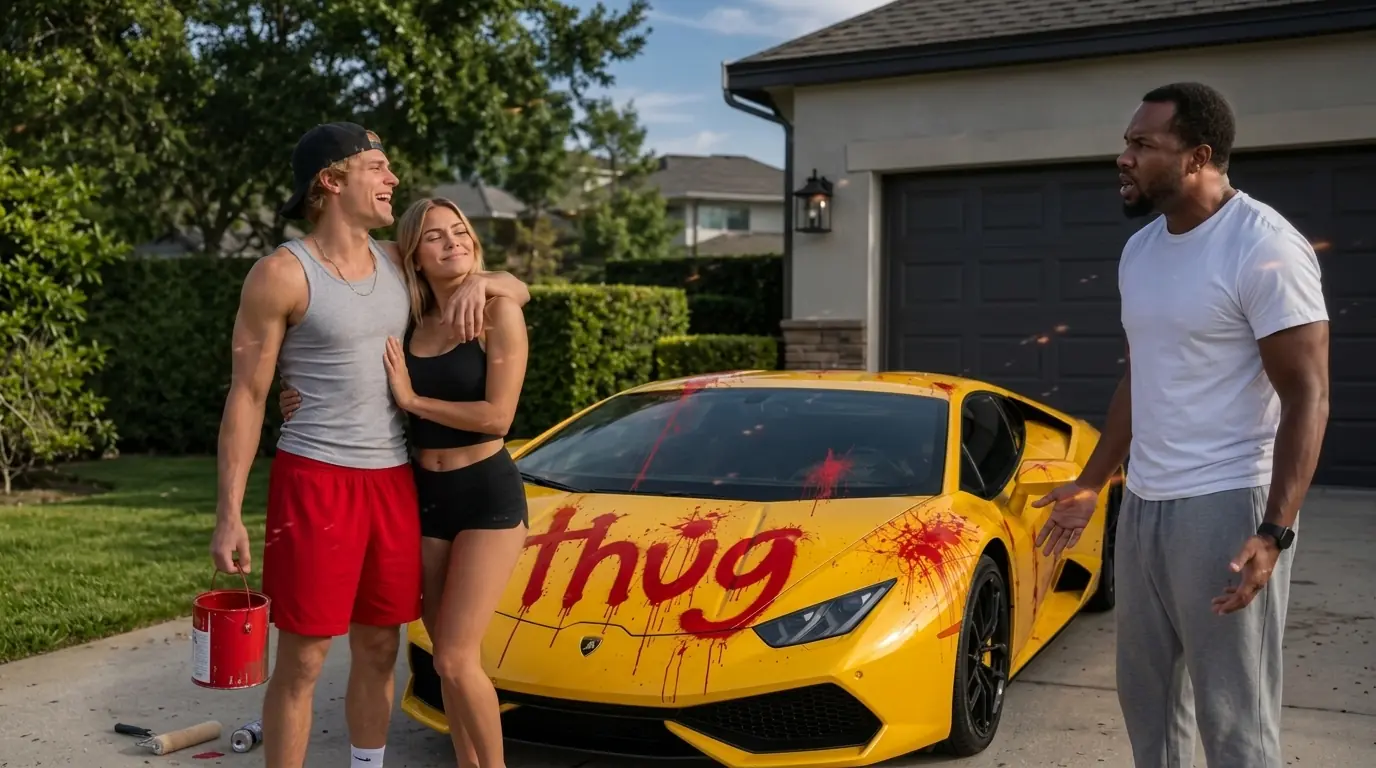
THE YELLOW CAR THEY TRIED TO DESTROY
An original expanded American drama, told by Malcolm Bennett
PROLOGUE — The Morning the Street Went Quiet
The boy was laughing when I stepped onto my driveway.
He held an open can of red paint in one hand, and his girlfriend held a phone in both of hers. Behind them, the bright yellow Lamborghini I’d spent twelve years earning looked like a warning somebody had written across my life.
Red paint rolled from the hood in thick uneven streams. It crossed the windshield, crawled beneath the wiper blades, and collected at the edge of the carbon-fiber splitter. The driver’s-side mirror hung at the wrong angle. Someone had left a shoe print on the door. Across the hood, in letters broad enough to read from the sidewalk, was one word.
FRAUD.
For a moment I thought I had walked into somebody else’s morning. I heard a lawn sprinkler ticking three houses down and a bird picking at the bark of the maple beside my porch. I heard the young woman giggle. I heard my own coffee slosh against the rim of the mug.
Then the boy lifted the can toward me.
“Morning, Malcolm. You like the upgrade?”
His name was Dylan Hargrove. Nineteen years old. New sneakers every other week. The kind of boy who had never been required to finish an apology because his mother always arrived to explain why he shouldn’t have needed to make one.
His girlfriend, Brooke, moved her camera closer to my face.
I set the coffee beside a flowerpot and took out my phone.
“Go ahead,” Dylan said. “Get my good side.”
I photographed the paint on his fingers, the can, the footprints and the damage. I walked around the vehicle without touching it. I took wide shots of the driveway, including the position of Brooke’s phone. I made a note of the time. Six forty-one in the morning.
The garage window reflected three figures: the boy smiling, the girl filming, and me standing still.
Then his mother crossed the street from the Hargrove house.
Vivienne Hargrove wore white linen trousers and an expression of practiced disgust. She didn’t look at the paint and ask who had done it. She didn’t ask why her son was holding the can. She looked directly at me and said, “You probably painted it yourself. For the insurance.”
Dylan laughed so loudly that Brooke’s camera shook.
My jaw tightened. I felt anger rise from somewhere below language, familiar and hot. It would have been easy to scream. The neighbors were already gathering behind curtains. Everyone would have seen me lose my temper. For once, they’d have had an image of the man Vivienne had spent months telling them to fear.
I looked at the phone in my hand and thought about what she really wanted.
An angry Black man in a video. A convenient explanation. A way to make the car, the paint, and her son’s hands disappear behind my reaction.
So I didn’t give her one.
“I’m calling the police,” I said.
“You do that,” Dylan answered. “Nobody here believes you anyway.”
His mother smiled at me as though the matter were already finished.
She had no idea what the camera above the house across the street had recorded. Neither did I.
And for the next several hours, that difference would matter more than the Lamborghini.








