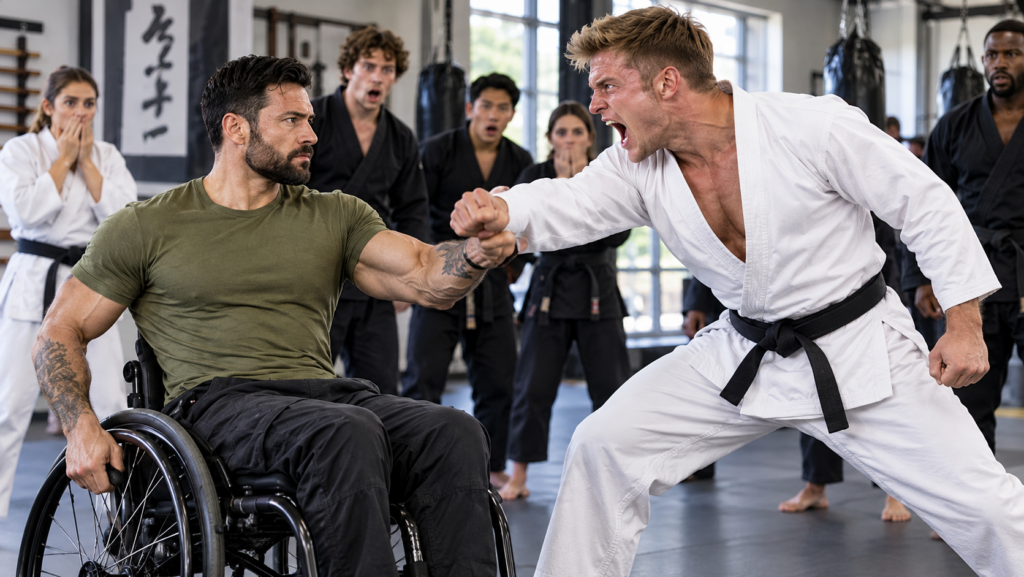
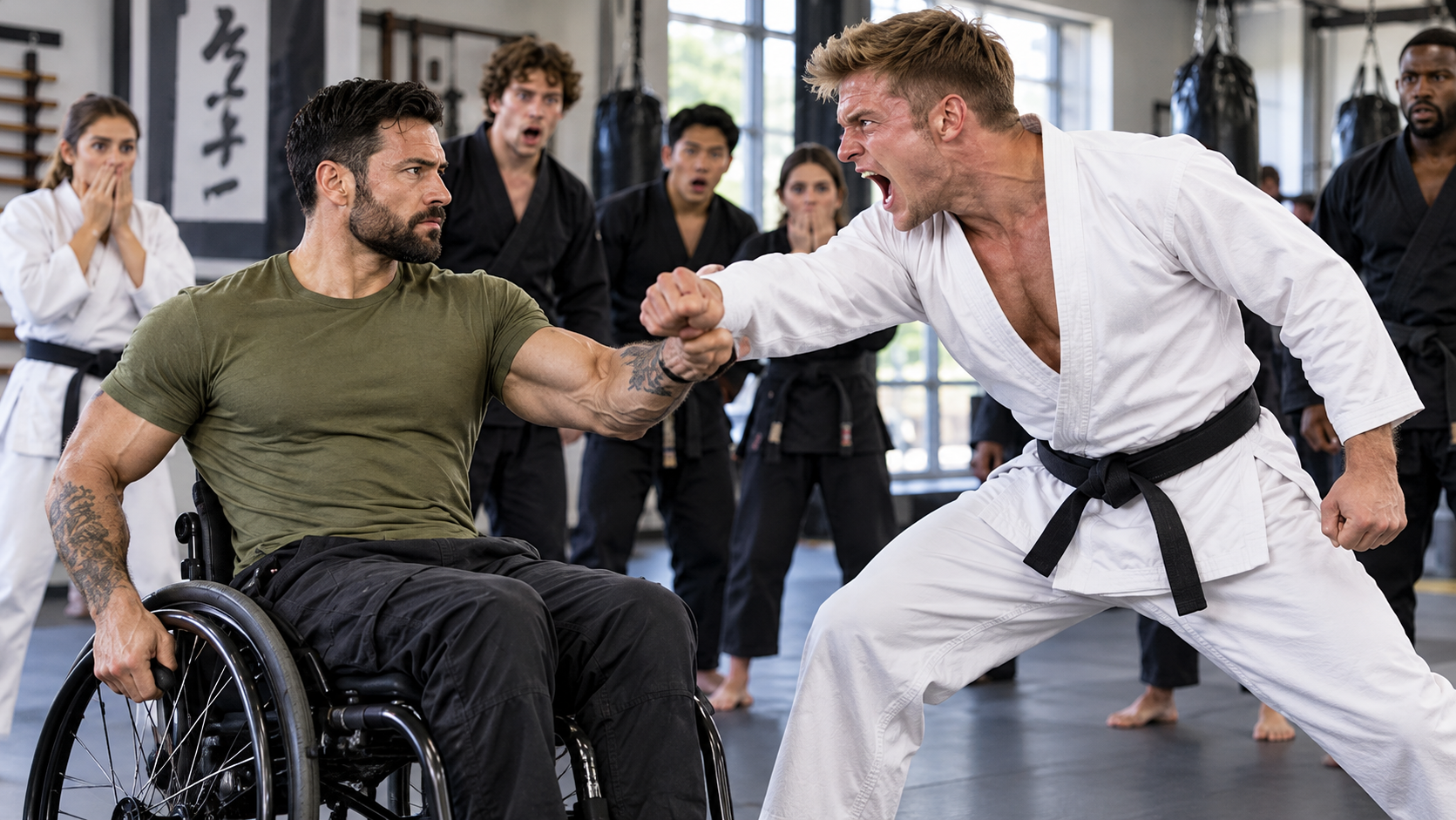
The black belt grabbed wheelchair mechanic Rowan in front of his students, certain the camera would capture an easy victory. Rowan had come for the money Bryce promised to repair his van. But as Bryce tightened his grip, Rowan was already reading the planted foot, turned hip, and opening beside his elbow. Then the chair pivoted, the black belt’s balance vanished, and the dojo fell silent. What Bryce meant as a demonstration became a lesson no one in the room expected.
For Rowan, the silence in the dojo was only a moment. Outside it, rent still came due, and his van still needed repairs. A spinal injury had ended his work in a full-service shop, but it hadn’t taken away his skill with engines. He now fixed neighbors’ cars in the narrow garage behind his rented house, choosing jobs he could finish before the bills caught up. Bryce knew Rowan needed the money. He offered to pay for the van repair if Rowan appeared in a self-defense video.
At the dojo, however, the deal changed. Bryce presented him as someone helpless, then challenged him to escape a grab while students watched. Rowan’s wheelchair shaped the room’s expectations. His training had taught him to notice what those expectations missed: balance, leverage, and the split second before a move committed. So was Bryce’s mistake simply underestimating Rowan, or did the way he staged the demonstration leave him nowhere to go? The answer began long before the camera was ready.
The camera was ready at the dojo because Bryce had promised his students a simple lesson. A confident instructor could show anyone how to escape a grab. The plan sounded straightforward when he pitched it. Rowan would sit in his wheelchair. Bryce would demonstrate a hold, and the footage would promote the school’s self-defense classes. But the promise had come with a price Rowan couldn’t ignore.
The van was more than transportation. It carried tools and parts between his garage and his customers, and without it, even a small repair could become a costly ordeal. Rowan had been putting off the work it needed, hoping the next week’s jobs would cover the bill. Bryce offered to pay the mechanic’s invoice in exchange for an afternoon of filming. Rowan understood the bargain. He also understood what it could become.
He asked what the video would show, and Bryce described a practical demonstration, something useful for people who didn’t fit the usual image of a martial arts student. It sounded like a chance to show that self-defense could be adapted. Rowan agreed to come. The arrangement made sense, partly because Rowan already knew how to teach people to pay attention. In his garage, a repair began with listening. A faint rattle, a belt slipping, an engine struggling under load. The obvious symptom wasn’t always the cause. A good mechanic watched for what changed when pressure shifted.








